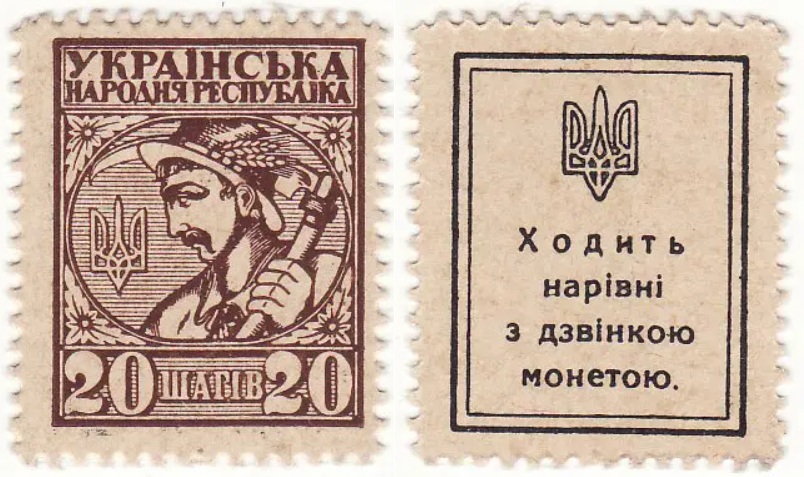
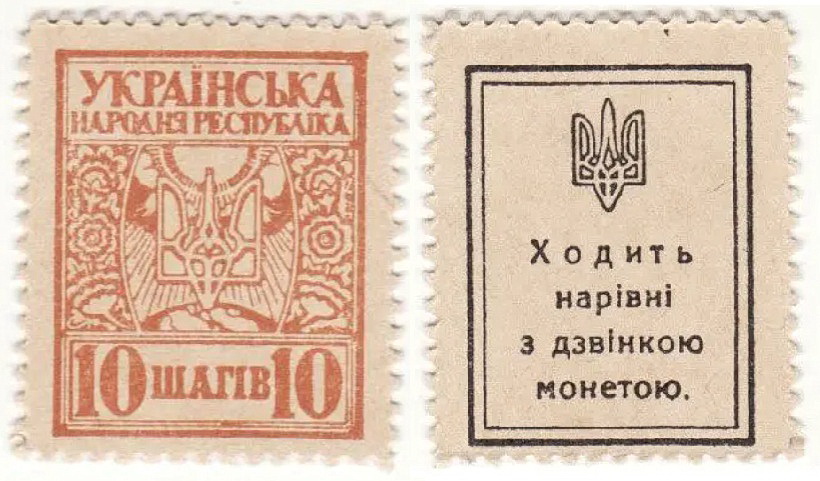
 The first standard postage stamps of the Ukrainian People's Republic (UPR), issued in 1918, entered the history of philately and numismatics as “money stamps” or “shahivky” (from the name of the monetary unit — the shah). They combined the function of postage stamps with that of small-denomination currency in conditions of an acute shortage of small change.
After the independence of the Ukrainian People's Republic was proclaimed by the Third Universal of the Central Rada in November 1917, the young republic faced a severe shortage of small-denomination currency. Silver and copper coins of the Russian Empire were rapidly disappearing from circulation. In April 1918, the Central Rada passed a law providing for the issue of fractional money stamps in denominations of 10, 20, 30, 40 and 50 shahiv (1 hryvnia = 100 shahiv, 1 karbovanets = 200 shahiv). The designs were created by prominent Ukrainian artists Heorhii Narbut (30, 40 and 50 shahiv) and Anton Sereda (10 and 20 shahiv). The text on the reverse of the money issue read: “Ходить нарівні з дзвінкою монетою” (“Circulates on a par with hard currency”).
The stamps were printed in Kyiv at the printing house of Vasyl Fesenko, as well as at the printing house of the Joint-Stock Company “Kultura.” Due to the wartime situation, the stamps were used simultaneously as postage stamps and as currency — until the end of 1920. Series description (designs and denominations):
10 shahiv (light brown / light violet): a Narbut-inspired motif, with the denomination in an oval ornamental frame at the center (artist Anton Sereda).
20 shahiv (brown): a peasant holding a sheaf of wheat is depicted in the center (artist Anton Sereda).
30 shahiv (dark blue): an allegory of “Young Ukraine,” represented by the head of a girl wearing a wreath (artist Heorhii Narbut).
40 shahiv (green): the Tryzub — the national coat of arms of Ukraine — surrounded by a floral ornament (artist Heorhii Narbut).
50 shahiv (red / carmine): the denomination “50 шагів” in large lettering in the Baroque style (artist Heorhii Narbut).
Since the series was issued both perforated (for postal purposes) and imperforate (as fractional money stamps), international catalogues record the principal types and varieties as follows:
Scott: Nos. 1–5
Michel: Nos. 1–5
Stanley Gibbons: Nos. 1–5
Yvert & Tellier: Nos. 1–5
Important cataloguing notes
Imperforate varieties: In the Michel and Scott catalogues, imperforate issues printed on thick card with text on the reverse are classified under the letter “a” following the main catalogue numbers (for example, Scott #1a–5a), or are listed in a special “Geldmarken” (money stamps) section.
Inverted overprints / shifts: In 1919–1920, overprints were applied to the shahivky, including “Tryzub” overprints of various gubernias, as well as overprints indicating denominations in hryvnias/karbovantsi. In the Michel catalogue, these issues have separate numbering in the “Ukrainische Feldpost / Lokalausgaben” section.
Collecting value and forgeries
Ordinary postage stamps (perforated): These are relatively common, as the print run amounted to tens of millions of copies.
Money stamps on card (imperforate, with text): In mint condition (MNH, without creases or damage to the card), they are considerably more valuable. The complete series of fractional money stamps in denominations of 10, 20, 30, 40 and 50 shahiv in UNUSED condition is traded on the European philatelic market from approximately €100.
Used examples (with cancellations from 1918–1920): These are of particular interest to collectors. Genuine cancellations from UPR cities (Kyiv, Kharkiv, Odesa, Poltava, etc.) can increase the value of a stamp many times over.
Forgeries: Forgeries of the heraldic overprints (Tryzubs) on shahivky are very common. Many were produced in the 1920s for sale to collectors.